What the primary record establishes
The strongest sources answer different questions. Keeping their roles separate
prevents a research definition from being mistaken for a rule or a regulatory
responsibility from being mistaken for a complete autonomy model.
FAA guidance: In the US Part 107 context, section 5.2.3 of
FAA Advisory Circular 107-2A
describes an automated operation in which a remote pilot enters a flight plan
and onboard components make flight-control inputs. The guidance says the remote
pilot in command must retain the ability to change routing or altitude, command
an immediate landing, or otherwise direct the aircraft through manual or
automated commands. The advisory circular is nonbinding guidance, not a rule or
legal interpretation.
Current regulation:
14 CFR 107.19
separately makes the remote pilot in command directly responsible for the
operation, requires compliance with applicable regulations, and requires the
ability to direct the small unmanned aircraft. Those are current Part 107
responsibilities. They do not define every possible autonomous system or settle
how another jurisdiction, approval basis, or future operating concept allocates
authority.
Attributed research position: A 2017 NASA conference paper,
Autonomy and Automation, prepared
for an ICAO Remotely Piloted Aircraft Systems Panel meeting, proposed describing
automation by the particular system, task, context, and relevant dimensions. It
also proposed avoiding the term autonomy for automated functions on remotely
piloted aircraft. That is a useful task-specific framing, but this article does
not represent the proposal as an adopted ICAO definition.
Historical government framework: NIST's September 2004
Autonomy Levels for Unmanned Systems terminology
Version 1.1 treated autonomy as multidimensional. Its framework considered
mission complexity, environmental difficulty, and human interaction, and noted
that autonomy designations could apply to tasks below the mission level. NIST's
current
ALFUS program page
lists a later Version 2.0 and warns that the page is no longer updated and may
be out of date. The durable lesson is context, not a current universal level
number.
These records support three conclusions. Automation can perform substantial
flight-control and mission-sequencing work. Human responsibility can remain in
place even when control inputs originate onboard. Autonomy should be described
at the level of a specific decision and context. None of the records supports
calling an entire UAS autonomous because it follows waypoints, returns after a
link interruption, or includes software marketed as AI.
Use the function as the unit of analysis
An aircraft-level label compresses too many different functions. A typical
system can close stabilization loops, estimate state, follow guidance targets,
sequence payload actions, detect hazards, recommend a new plan, and execute a
contingency. Each function can have a different source of authority and a
different degree of adaptation.
The practical unit is:
named function + operating context + delegated decision + transition rule
Consider route behavior. Holding a commanded course is automated control.
Following a preloaded waypoint list is automated execution. Presenting three
alternate routes for a person to select is decision support followed by
automation. Selecting one of those routes from current observations can be a
bounded autonomous decision function if the selection, constraints, authority,
and transition behavior are explicit. None of those descriptions alone
classifies the rest of the aircraft.
This function-level view also separates flight control from mission authority. A
planner may receive authority to avoid an obstacle while the operator retains
authority over the destination and mission continuation. A payload scheduler may
choose a trigger time without receiving authority to change the flight path.
Different decisions can share software and hardware while remaining distinct in
the authority map.
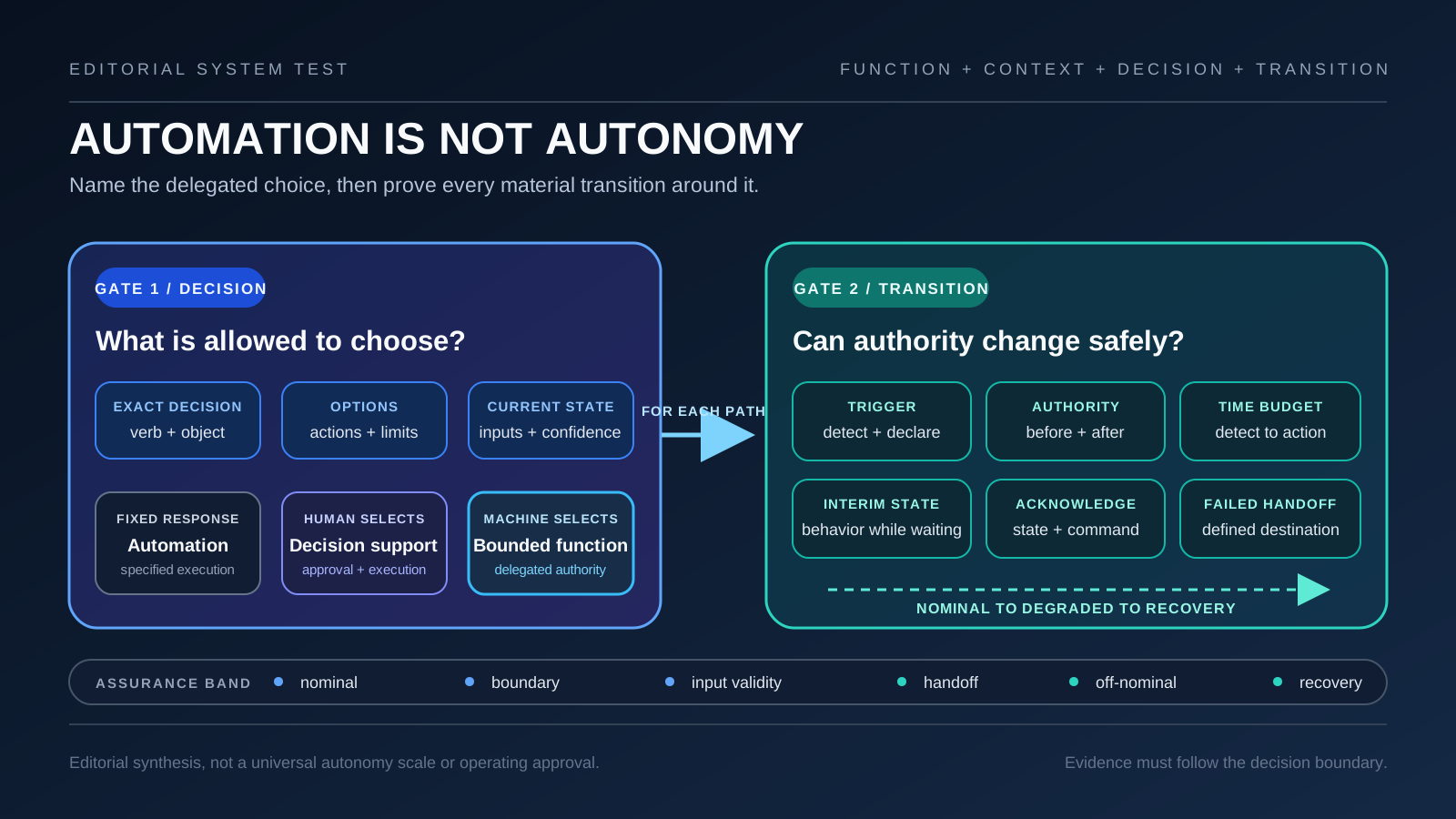
The decision-authority and transition test
The six-part test below is Unmanned Innovation editorial analysis
synthesized from the cited regulator and research records. It is designed to
expose missing requirements and evidence, not to award an autonomy level.
1. Name the exact decision
State the choice as a verb with an object and a condition. "Fly autonomously" is
not testable. "Select a route around a detected obstacle while preserving the
operator-approved destination" identifies a decision. So does "choose one of
three approved landing areas after the primary area becomes unavailable."
Then ask whether a choice exists. A fixed response to a fixed trigger is still
automation, even when it occurs without a new human command. A preprogrammed
return route, timed camera trigger, altitude hold, or deterministic lost-link
sequence can be sophisticated and safety-relevant without exercising delegated
choice among alternatives.
2. Enumerate actions and constraints
List what the function may select, what it must reject, and what it cannot
change. Relevant constraints can include a geographic boundary, destination,
energy reserve, speed or altitude limit, required separation, sensor-confidence
threshold, time limit, or operator prohibition. The list must also state how
conflicts among constraints are resolved.
Constraints do not prove good decisions by themselves. A geofence can prevent
one class of excursion while leaving route obstruction, energy, navigation
integrity, or traffic unresolved. A reviewer needs to know which constraints are
enforced, which are advisory, which have priority, and what happens when no
permitted action remains.
3. Identify the authority holder
For each decision, identify who or what may propose, approve, select, execute,
pause, override, and terminate. "Human supervised" is incomplete because those
verbs can be distributed differently.
Scroll horizontally to compare all columns.
The authority statement must cover the current operation, not just the design
intent. Under Part 107, the cited FAA rule governs remote-PIC responsibility and
the required ability to direct the aircraft; the advisory circular illustrates
the FAA's automated-operation guidance. A technical allocation cannot replace
that regulatory allocation.
4. Specify every material transition
A mode label describes a state. A transition contract describes how the system
enters and leaves it. For each transition, record:
- the initiating event and the component or person that detects it;
- the outgoing and incoming authority holder;
- the information presented to the receiving party;
- the allowed response time and how that budget was derived;
- the aircraft behavior while acknowledgement or action is pending;
- the commands that remain available;
- the completion acknowledgement and resulting mode; and
- the response when the transition itself does not complete.
This is where a nominally human-authorized design can fail in practice. A person
cannot meaningfully take authority if the alert is ambiguous, the system state
is stale, the command path is unavailable, or the remaining time is shorter than
detection, comprehension, decision, and command execution. The
UAS data-link role map explains why command,
state telemetry, payload data, and video must be evaluated as separate
information flows even when they share a radio.
5. Define degraded behavior
Name every prerequisite the function relies on, including state estimates,
sensor coverage, time synchronization, maps or constraints, command and state
paths, compute resources, and energy. For each prerequisite, state how loss or
degradation is detected, how confidence changes, and which decisions remain
permitted.
The next action can be a restricted mode, a fixed contingency, a request for
human approval, transfer to another function, or termination. The correct choice
is operation- and approval-specific, so this framework does not prescribe a
default. It requires the transition to be visible and testable.
Return-to-home illustrates the distinction. A fixed return command can be an
automated contingency. If a function evaluates several landing or routing
options using current state, that selection may exercise bounded decision
authority. Neither label proves that the route, home point, navigation source,
energy margin, communications behavior, or surrounding hazards make the outcome
acceptable.
6. Match evidence to the claim
Evidence should cover the decision and every consequential transition, not just
successful nominal execution. At minimum, the claim-to-evidence map should
distinguish:
Scroll horizontally to compare all columns.
Test volume alone is not the claim. The record should connect requirements,
analysis, scenarios, configurations, results, unresolved anomalies, runtime
monitoring, and operational limits. A demonstration of one route or one fault
injection cannot establish coverage of an unspecified decision space.
Human authority must be operationally usable
Human-in-the-loop, on-the-loop, and out-of-the-loop labels can describe broad
interaction patterns, but they do not specify who decides each action or how a
handoff works. The 2017 NASA paper discussed these terms while arguing for task-
and context-specific descriptions. The more useful review asks what a particular
person can know and do at the moment authority changes.
A 2018 NASA contractor report
identified challenges created by adaptive or nondeterministic behavior, possible
divergence between the system's state awareness and the human's, and dynamic
transfer of authority. It also noted that responses must occur on a timescale
appropriate to the system and environment. These are attributed research
findings, not a rule for small UAS.
A valid handoff claim therefore needs evidence for the whole human-machine path.
That includes detection, alert salience, mode and authority indication, the
information needed to form an accurate picture, decision time, command
availability, command acknowledgement, and the system's behavior during the gap.
Merely displaying an override control establishes interface presence, not
effective supervisory control.
NASA's 2025 technical memorandum on
human-machine teaming in aviation
frames novel role allocations as a whole-team research problem. Its abstract
calls for evidence about holistic team performance, human resilience to
unforeseen hazards, assurance of enabling components, and clear, timely,
accurate communication. Editorial inference: a system claim that credits a
human as a safety mitigation should include the human, interface, communication
path, and time budget inside the assurance boundary.
Degraded modes are transitions, not feature names
"Fail-safe," "lost-link protection," and "graceful degradation" are conclusions
that require a defined hazard and evidence. They are not properties established
by naming a mode.
Use a transition record for each required input:
Scroll horizontally to compare all columns.
These examples are architecture questions, not flight procedures. Their values
and acceptable responses must come from the actual system, operation, hazard
analysis, manufacturer information, and applicable approval basis.
The transition also needs a destination. "Autonomy disengaged" says what stopped
but not what controls the aircraft next. A defensible record names the receiving
function or person, the interim aircraft behavior, available state information,
and what happens if the receiver cannot accept authority.
Assurance follows the authority boundary
An automated sequence with fixed inputs and outputs can often be reviewed
against a bounded set of states. A function that selects new actions from live
observations expands the relevant state and decision space. A function that
adapts its policy or contains nondeterministic components can raise further
verification and validation questions. That does not make adaptation unsafe by
definition. It means the evidence burden must match the behavior actually
claimed.
The 2018 contractor report treats increasingly autonomous systems as a
multidimensional challenge affecting safety-assurance methods, architecture, and
verification and validation. It does not supply a certification shortcut. For
this editorial test, a credible evidence package answers four separate
questions:
- Specification: Are the delegated choices, constraints, transitions, and
prohibited states explicit?
- Implementation: Is there evidence that the function enforces that
specification in the identified configuration?
- Integration: Do sensors, estimators, communications, interfaces, and
flight controls preserve the assumptions the decision function needs?
- Operation: Are the context, human roles, monitoring, maintenance, and
approval consistent with the tested boundary?
Evidence for one layer cannot silently answer another. A planner simulation does
not establish sensor validity. A successful flight does not prove all boundary
transitions. A technical capability does not grant regulatory authority. The
related explainer on
Remote ID, detect-and-avoid, and UTM
applies the same discipline to functions that are often grouped together even
though they solve different problems.
Test common autonomy claims
The following outcomes are editorial classifications under this article's
framework, not universal definitions.
"It flies a waypoint mission without stick input." The supported conclusion
is automated mission execution. Ask who selected the route, whether the system
can choose among alternatives, and what decisions remain after conditions
change.
"It has AI obstacle avoidance." The label does not identify the authority
boundary. Determine whether the function only issues a stop, recommends an
alternate path, or selects and executes one. Then identify observations,
constraints, confidence limits, and transitions.
"A human is always on the loop." Presence is not the same as usable
authority. Identify the exact decisions the person can change, the state they
receive, communication dependencies, response window, and evidence for the
handoff.
"It safely returns after losing the link." A fixed lost-link sequence is
automation. Safety remains conditional on detection, configuration, route,
navigation integrity, energy, hazards, and the operation's rules and approvals.
"It is autonomy level 4." A number without the named framework, task,
environment, human interaction, configuration, and evidence is not portable. The
historical NIST work itself used multiple dimensions. Translate the number back
into function-level claims before comparing systems.
Write a capability statement that can be tested
Replace the broad label with this template:
Within [context and validated inputs], [function] may select [named
actions] to achieve [human-approved objective], subject to
[constraints and prohibited states]. [person or function] retains
authority over [decisions] and can intervene through [information and
command path]. Loss or degradation of [prerequisites] triggers
[transition and interim state]. The claim is supported by [requirements,
analysis, scenarios, tests, monitoring, and limits].
For example, a defensible description might say that a route planner may select
and revise a path to an operator-approved destination inside a defined area when
specified position and obstacle inputs are valid. It might reserve destination
change and mission termination to the remote pilot, identify the command and
state paths, and define a fixed contingency if input confidence falls below a
documented boundary. That description is hypothetical. It shows the needed
fields without claiming that any product satisfies them.
Before accepting the statement, ask:
- Is the exact decision smaller than the whole mission label?
- Are all options, constraints, priorities, and prohibited states named?
- Can the system detect when required information is no longer valid?
- Is the authority holder known in nominal, transition, and degraded states?
- Can a human intervention credited by the claim occur with adequate state,
command access, and time?
- Does every handoff have an acknowledgement, interim behavior, and failed
transition response?
- Does the evidence cover boundaries and off-nominal cases as well as nominal
demonstrations?
- Are technical capability, operating approval, and pilot responsibility kept
separate?
Automation can reduce workload and improve repeatability. Bounded autonomous
functions can add useful adaptability. Neither term, by itself, proves safe
integration, regulatory approval, or acceptable operational risk. The defensible
claim is the smallest one that states the decision, its authority boundary,
every material transition, and the evidence that remains valid when the system's
assumptions stop being true.